Safeguarding Your IT Help Desk from AI-Driven Vishing Attacks
How prepared is your organization to combat AI-powered vishing threats that target the IT help desk? With technology rapidly evolves, so do the methods of cybercriminals, with AI-driven attacks becoming increasingly sophisticated. One prevalent threat is vishing, or voice phishing, where attackers use AI-generated voices to trick employees into revealing sensitive information. This necessitates a robust defense strategy to protect the IT help desk, which serves as a critical junction point for organizational communication.
The Rise of AI-Driven Vishing
With advancements in AI, cybercriminals have developed tools to create realistic voice deepfakes that mimic the tone and speech patterns of trusted organizational figures. These AI-generated voices are used in vishing attacks to deceive help desk staff into providing unauthorized access or divulging confidential data. The consequences are severe, ranging from financial loss to significant reputational damage.
AI-powered vishing exploits the human element, manipulating employees’ trust and exploiting their willingness to help. Hence, it’s crucial for organizations to implement strategies that detect and block these threats at their source.
Proactive Vishing Bot Defense: The First Line of Defense
A proactive approach to vishing bot defense requires advanced technology that can identify and neutralize threats before they penetrate internal systems. Key aspects include:
- Real-Time Detection: Implementing solutions that instantly recognize and halt suspicious interactions when they occur. This involves utilizing advanced algorithms to analyze voice patterns and detect anomalies.
- Multi-Channel Security: Protecting the organization across various communication platforms, such as email, phone calls, and collaboration tools, to ensure comprehensive coverage against vishing attacks.
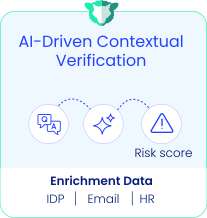
- Context-Aware Verification: Leveraging identity verification techniques that consider the context of interactions, ensuring that requests for sensitive information are legitimate.
Realistic Threats and Their Impact
Vishing threats are no longer hypothetical. According to a recent report, many organizations have fallen victim to voice phishing scams that resulted in substantial financial losses. These attacks often exploit social engineering tactics, creating a false sense of urgency to coerce employees into compromising actions.
For example, attackers might impersonate a high-ranking executive requesting urgent access to confidential systems. Without proper vishing bot defense in place, the help desk might unknowingly facilitate these unauthorized requests, leading to catastrophic breaches.
Implementing Multi-Channel Security
A multi-channel approach to security is essential in safeguarding against AI-driven vishing. Such an approach encompasses:
- Unified Security Solutions: Deploying solutions that integrate seamlessly with existing workflows, ensuring protection across all communication channels without disrupting operations.
- Privacy-First Approach: Emphasizing privacy by adopting a zero data retention policy, which means no sensitive information is stored during verification processes.
- Continuous Monitoring and Adaptation: Leveraging AI engines that continuously update their algorithms to defend against newly emerging threats, adapting to evolving cyber threats.
Building Confidence in Digital Interactions
Restoring trust and confidence in digital interactions is paramount. With the rise of AI-driven vishing, organizations must ensure that their communication channels are secured against impersonation attempts. By implementing robust identity verification systems, businesses can reassure employees and stakeholders that their digital interactions remain secure and trustworthy.
This involves fostering a culture of vigilance and awareness, whereby employees are educated about the signs of social engineering attacks and trained to question unusual requests. An informed workforce, combined with state-of-the-art technology, forms a formidable defense against AI-powered vishing attacks.
Protecting Mission-Critical Sectors
Organizations operating in mission-critical sectors must prioritize vishing bot defense to mitigate risks associated with deepfake and social engineering attacks. These sectors face heightened threats due to their reliance on sensitive data and high-stakes decision-making processes. By implementing comprehensive security measures, such as EU AI Act compliance, these organizations can safeguard their operations and protect their reputations.
Combatting AI-driven vishing attacks requires a holistic and proactive approach that emphasizes real-time detection, multi-channel security, and context-aware identity verification. Organizations must remain vigilant, continuously adapting to emerging threats and ensuring their defenses are robust and comprehensive. By safeguarding the IT help desk and implementing effective strategies, businesses can protect themselves from the severe consequences of vishing attacks and maintain trust in their digital interactions.
Integrating AI and Human Intelligence to Combat Vishing
In addressing AI-powered vishing threats, a balanced integration of artificial intelligence and human judgment is indispensable. How can organizations optimize this synergy to safeguard their systems? While AI offers superior processing capabilities to detect anomalies, human intuition excels at understanding context and intent. This blend is crucial because vishing attacks exploit human nature, requiring defense mechanisms that harness both technological advancements and human insight.
Human-AI Collaboration: Enhancing Security Effectiveness
AI alone can rapidly process vast amounts of data, identifying patterns that could signify potential threats. But it is the nuanced understanding of context by human operatives that often determines the legitimacy of a request. Here’s how organizations can leverage this collaboration:
- Augmented Intelligence: Implement AI systems that enhance human decision-making. For example, while AI can identify suspicious patterns in voice calls, human operators might interpret subtle cues that denote an attack.
- Training and Simulation: Regularly simulate vishing attacks to train staff, fostering a workplace culture that prioritizes security. This helps employees recognize and respond to potential threats more efficiently.
- Feedback Loops: Establish a system where employees can provide feedback on AI performance. This continuous loop helps improve AI algorithms by incorporating human insights.
The pressing need to adapt is underscored by reports of cyberattacks leveraging AI to evade detection. As the United States Department of State highlights, even unrelated fields are feeling the pressure to adapt due to pervasive threats AI is driving.
Statistical Insight: The Financial Burden of Vishing
Quantifying the financial impact of vishing attacks offers compelling insight into the urgency of adopting AI-human integrative strategies. Research indicates that cybersecurity incidents involving identity-related fraud, such as vishing, have cost organizations billions annually. By proactively implementing defense structures, potential financial losses can be significantly mitigated.
Illustrating this, the FBI warns of the increasing threat posed by AI-utilizing cybercriminals, emphasizing the need for vigilant and layered security measures to counteract these financial threats effectively.
Comprehensive Training and a Culture of Security
Fostering a culture of security is pivotal in any organization’s battle against vishing threats. Well-informed employees are less likely to fall victim to deceit.
- Regular Education: Provide employees at every level with ongoing training sessions about the latest vishing techniques and defense strategies. Awareness is the first line of defense.
- Questioning Culture: Encourage a questioning attitude towards unexpected requests for sensitive information, even when coming from seemingly legitimate sources.
- Clear Incident Reporting Channels: Establish and promote transparent channels for reporting suspicious activities without fear of repercussions.
Institutions like West Virginia University stress the need for students and staff alike to maintain vigilance and a strong security posture, which can be applied universally to counter acting threats.
Continuous Evaluation and Adjustment
A static security strategy becomes obsolete when threats evolve. Therefore, continuous evaluation and adjustment of security measures are imperative to ensure the efficacy of defense mechanisms against vishing.
Regular audits and assessments allow organizations to identify vulnerabilities and fortify them against potential exploits. Leveraging data analytics tools to assess these vulnerabilities can substantially enhance security protocols, keeping organizations one step ahead of cybercriminals.
Beyond the Help Desk: Wide-Scale Organizational Implications
While the IT help desk is often at the forefront of vishing attacks, the threat extends throughout entire organizations. Ensuring all departments adhere to stringent security practices can create a fortified perimeter against such intrusions.
Future-Proofing Through Innovation
Investing in next-generation technologies and innovation is crucial. By adopting technologies that predict and adapt to the evolving tactics of cyber adversaries, companies not only protect themselves but also set industry benchmarks.
By exploring robust self-service password reset options and integrating solutions for session hijacking, firms can enhance their security while empowering users with secure functionalities that prevent unauthorized breaches.
For mission-critical sectors, ensuring a resilient security framework not only combats present threats but anticipates future challenges, facilitating seamless operations and safeguarding reputation and assets. Through adopting a holistic, proactive identity management approach, organizations can effectively mitigate the threats posed by AI-driven social engineering. This strategic alignment between cutting-edge technological solutions and dedicated human resources provides an invaluable shield against potential security breaches and reinforces trust within digital interactions implementing strategies that foster a collective security mindset and progressive technology.