TL;DR: The 10-Week Media Timeline
Updated August 20, 2026.
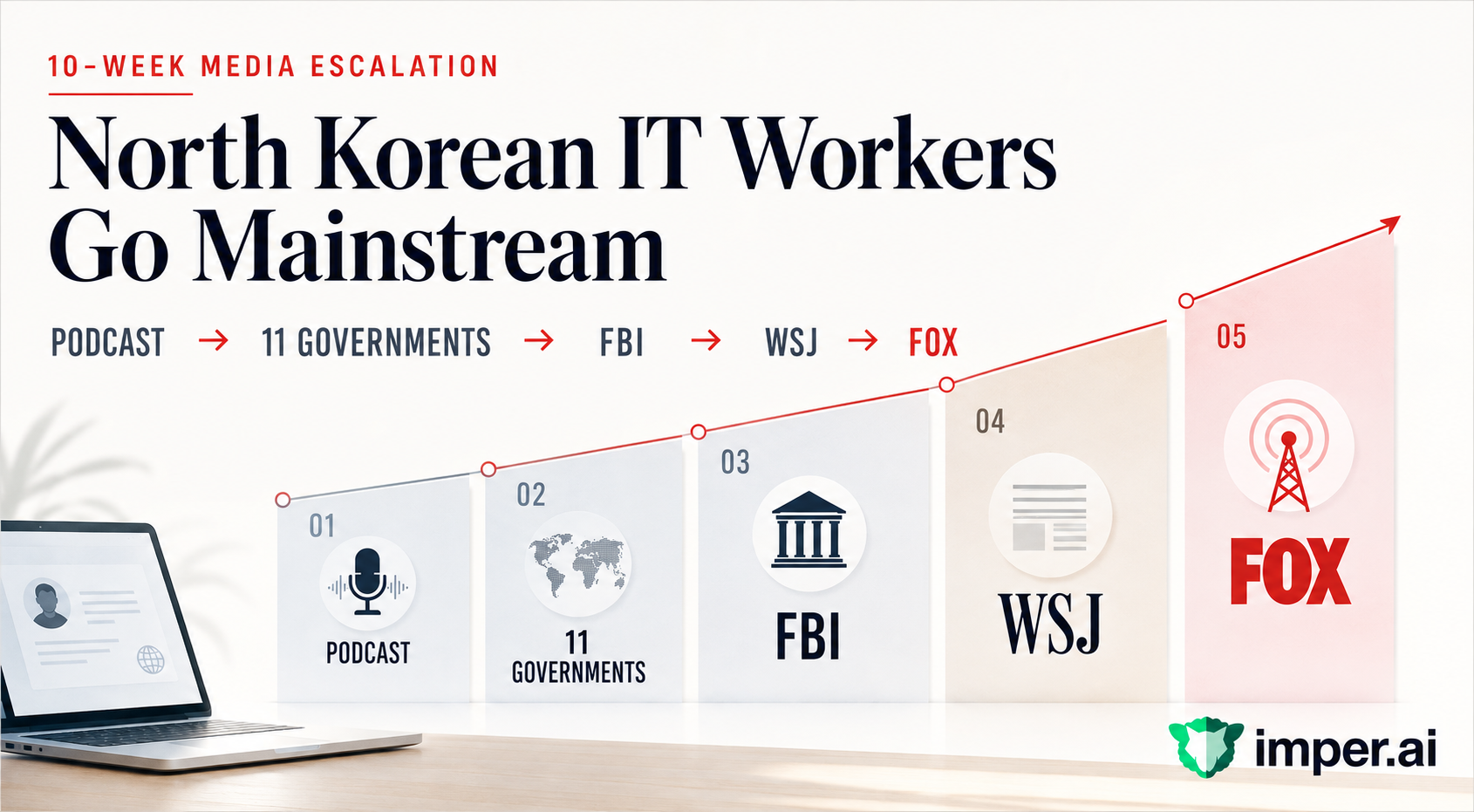
In ten weeks, North Korean IT worker activity moved from specialist cybersecurity reporting into government warnings, major investigations and national television.
The coverage also changed how the issue is being discussed. It is no longer viewed only as sanctions evasion or remote hiring fraud. It is increasingly treated as an identity security, insider risk and threat intelligence problem.
We previously examined the government guidance in “You Have Been Warned: Eleven Governments Just Put the North Korean IT Worker Threat on the Record.” This roundup tracks the broader media coverage before and after that warning.
- June 9 to July 14: Nicole Perlroth’s To Catch a Thief: North Korea on Our Payroll examined suspected worker cells, laptop farms, U.S.-based facilitators and companies that had unknowingly hired North Korean workers.
- July: CBS News interviewed Perlroth and brought the investigation to a national broadcast audience.
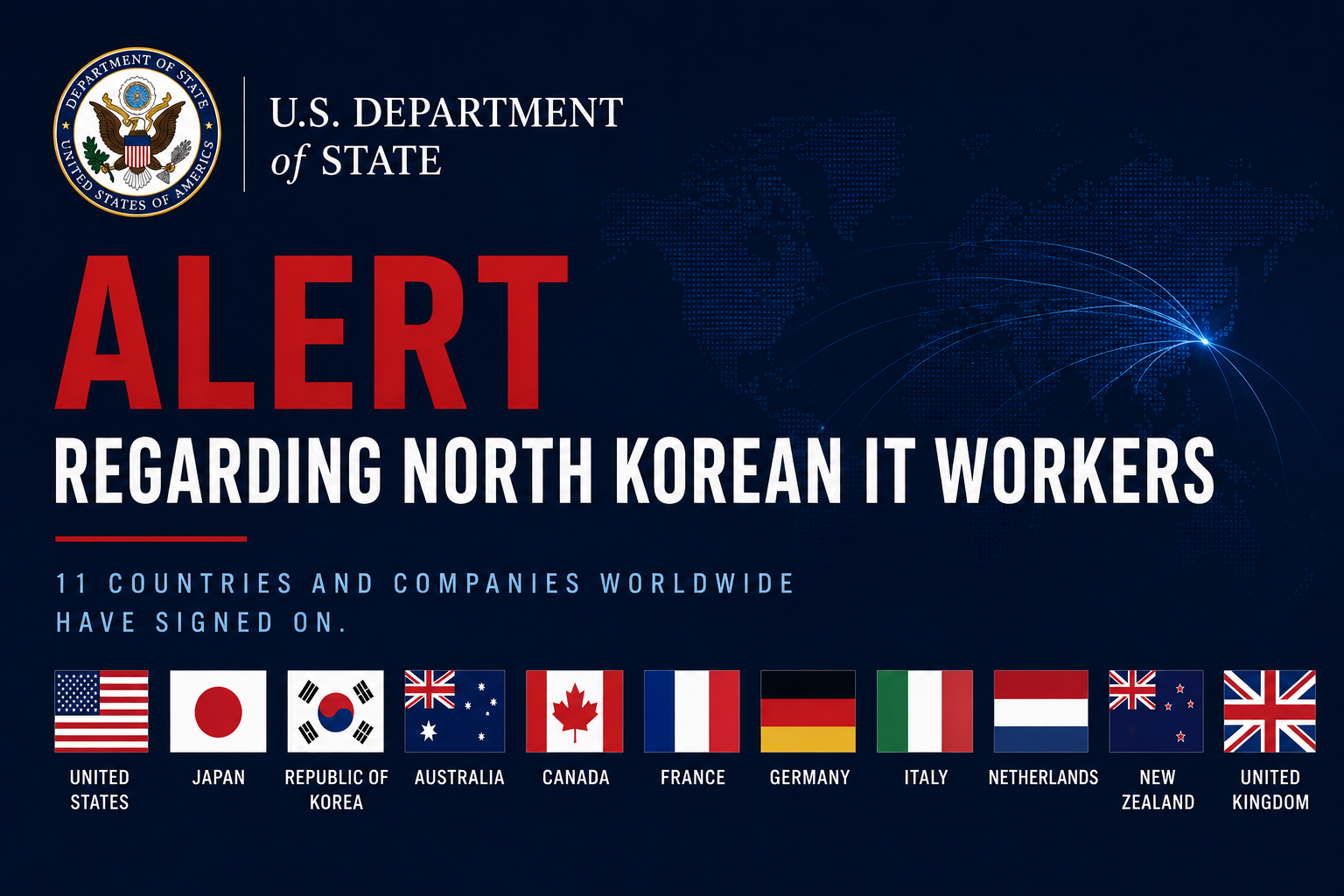
- July 31: The United States and ten partner governments warned employers about false identities, laptop farms, remote access, AI-assisted impersonation, sanctions exposure and insider threats.
- August 5: WIRED placed fraudulent employment within a wider set of North Korean campaigns targeting developers and technology companies.
- August 10 and 11: Federal News Network and TechCrunch reported that the FBI had identified an apparent DPRK remote IT worker employed by an unnamed U.S. federal agency.
- August 11 to 13: The Hacker News, The Cyber Brief and Laura Shin’s Unchained published interviews and investigations involving suspected or alleged DPRK-linked workers.
- August 13 and 14: The Wall Street Journal published a yearlong investigation and a video documentary examining identities, applications, laptops, facilitators and salary payments.
- August 14 to 20: Fox Business and Fox News took the subject to mainstream business and national television audiences.
How the coverage developed
Nicole Perlroth and CBS established the operating model
Former New York Times cybersecurity reporter Nicole Perlroth began publishing her six-part podcast investigation before the multinational government warning.
The series followed suspected worker networks, defectors, laptop farms and U.S.-based facilitators. It described a model in which a worker applies for a remote role using a false or stolen identity, while someone in the United States may receive the employer’s laptop and provide remote access to the actual operator.
A subsequent CBS News interview with Perlroth brought the investigation to a broader broadcast audience.
The reporting gave readers and listeners a clearer picture of how the people, identities, devices and payment arrangements fit together.
Eleven governments made the warning official
On July 31, agencies from the United States and ten partner countries issued a coordinated alert on North Korean IT workers.
The alert described the use of false identities, third-party facilitators, VPNs, remote desktop software, laptop farms and AI-assisted impersonation.
It also warned that the consequences could extend beyond fraudulent wages. A worker with legitimate access could steal sensitive information, intellectual property or cryptocurrency.
The importance of the notice was the level of agreement behind it. Eleven governments were describing the same activity as a sanctions, security and insider threat issue.
Five days later, WIRED reported on a wider set of North Korean operations targeting developers and technology companies.
The WIRED investigation included malicious recruitment and network compromise, not only workers obtaining legitimate employment. Its figures should not be treated as a count of companies employing DPRK IT workers. The report was still important because it placed employment fraud within a broader North Korean cyber ecosystem.
The FBI disclosure raised the stakes
On August 10, Federal News Network reported that the FBI had identified an apparent North Korean remote IT worker employed by the federal government.
The affected agency was not named. The FBI also did not disclose how the person was hired, how long the worker had access or whether sensitive information was exposed.
TechCrunch reported the disclosure the following day, bringing it to a wider technology, startup and venture audience.
The federal case turned a general warning into a specific example of the scheme reaching a government environment.
Undercover reporting showed how credible applicants can appear
The Hacker News reported on researchers who created a fictitious cryptocurrency company and engaged three people they assessed to be suspected North Korean IT workers.
Our team got the chance to witness the researchers, Heiner G. and Mauro Eldritch, present their findings live during DEF CON 34 earlier this month.
They described conflicting identity and banking information, VPN use, remote desktop software, AI-assisted applications and an identity image that appeared to have been processed using generative AI.
The attribution came from the researchers and had not been publicly confirmed by a government agency.
Laura Shin’s Unchained episode documented an undercover interview with an alleged DPRK-linked developer.
One of the most important observations was that the applicant appeared technically capable.
A fraudulent applicant does not have to be unqualified. A person can write code, answer technical questions and perform assigned work while still concealing their identity, location or affiliation.
The practitioner discussion was also expanding. On August 12, The Cyber Brief interviewed Nisos CEO Ryan LaSalle about an investigation into a suspected worker network reportedly employed across multiple U.S. organizations.
Together, these reports showed why basic interview screening may not be enough.
The Wall Street Journal connected the pieces
The Wall Street Journal’s investigation used browser histories, messages, calendars and screen recordings to examine a North Korean worker operation.
Its reporting connected stolen identities, job applications, AI tools, U.S.-based facilitators, corporate laptops and salary payments.
The Journal also produced a video documentary, making the operating model easier to understand for audiences outside the cybersecurity sector.
The investigation showed that this is not simply a fake résumé problem. It is an organized process that can involve multiple people, accounts, devices and locations.
Fox expanded the audience
Fox Business covered North Korean operators using AI to obtain jobs at U.S. companies.
Fox News followed with national reports on North Korean IT workers obtaining remote jobs at American companies and operatives using false identities to target employers.
The Fox segments did not provide the same level of original investigation as the FBI disclosure or The Wall Street Journal reporting.
Their significance was distribution. The subject had moved from government notices, cybersecurity publications and industry podcasts into mainstream business and national television.
Whose problem is this?
North Korean IT worker activity does not fit neatly within one department.
Many of these workers may not behave like conventional malicious insiders. They can write code, attend meetings, close tickets and meet deadlines. In daily activity, they may appear to be “just doing their job,” and may be doing it well.
The risk may sit in the worker’s concealed identity, location, state affiliation, payment destination or the possibility that someone other than the named employee is operating the device and account.
That makes the activity difficult to identify through conventional insider risk controls.
Many insider threat systems look for unusual behavior after access has been granted, such as excessive downloads, privilege abuse, policy violations or data exfiltration. A worker using approved credentials to perform expected tasks may not trigger those controls.
Detection requires several teams to examine different parts of the same hiring, identity and access process.
Talent acquisition
Talent acquisition may be the first team to encounter inconsistencies.
A technically strong interview can create false confidence. It shows that someone can perform the work, but it does not prove that the applicant is using their own identity, operating from the claimed location or acting alone.
Recruiting teams need to look for identity continuity across the application, interviews, offer, onboarding and equipment delivery.
Identity
Identity teams typically confirm that an account has passed authentication.
The harder question is whether the account is being operated by the person the organization intended to hire.
Identity controls need to connect the employee, account, device, network and location. Verification should continue through onboarding, device activation, account recovery and other high-risk events.
Operations, help desk and IT
Operations, help desk and IT teams may see important indicators as isolated support issues.
These can include:
- Requests to ship equipment to an unrelated address
- Immediate installation of remote access software
- Repeated MFA resets
- Unusual device enrollment requests
- Geographic inconsistencies during support sessions
- A user who depends on another person to complete local device actions
Individually, these events may appear routine. Together, they may indicate that the person operating an account is not the employee the company believes it hired.
Insider risk and insider threat
Insider risk teams traditionally focus on what a trusted user is doing.
This activity requires an earlier question:
Is the trusted user actually the person the organization believes them to be?
Existing insider threat controls remain useful for detecting theft, misuse and unusual access. They are less effective when a worker performs expected activity under a false identity.
Insider risk teams therefore need information from recruiting, identity systems, device telemetry, network monitoring and help desk records.
Threat intelligence
Threat intelligence teams can identify external patterns, including DPRK tactics, laptop farms, facilitators, identity reuse, remote access infrastructure and payment methods.
The challenge is converting that reporting into operational controls.
Threat intelligence should inform interview and onboarding procedures, detection hypotheses, help desk escalation rules, device monitoring, staffing requirements and incident response playbooks.
Information also needs to flow in the other direction. A reused address, suspicious onboarding event or unusual device configuration may help threat intelligence teams identify a wider campaign.
No single team has the full picture
Talent acquisition sees a qualified candidate.
Identity sees documentation and successful authentication.
IT sees a managed laptop.
The help desk sees an account reset.
Insider risk sees activity consistent with the employee’s assigned role.
Threat intelligence sees an external adversary pattern but may not see the internal employment event that matches it.
The worker benefits from those gaps.
Finding these operators requires shared signals, clear escalation procedures and verification that continues after hiring.
How imper.ai can help
imper.ai analyzes device, network, virtualization, remote control and behavioral signals during remote hiring and onboarding.
These signals can help talent acquisition, identity, IT, insider risk and threat intelligence teams identify suspicious operating environments before credentials or sensitive access are issued.
Read imper.ai’s DPRK IT worker research or request a demo.